
Calaveras County Parole vs Probation
Parole and probation both happen after a person is out of locked custody, but they come from different systems. In Calaveras County, probation is tied to the Superior Court case. It may be ordered instead of a jail term, after a jail term, or after a court modifies a sentence. The local supervision office is the Calaveras County Probation Department. A probation record may appear through the court docket as sentencing, modification, violation, review, or termination activity.
State parole is different. It follows release from California Department of Corrections and Rehabilitation custody. CDCR's Division of Adult Parole Operations supervises state parole, and the Board of Parole Hearings handles parole suitability proceedings for many state prison cases. Calaveras County does not have a confirmed public parolee lookup that works like a jail roster. The assigned office is best confirmed through parole paperwork, DAPO contact, CDCR records, or the person under supervision.
| Supervision type | Who handles it | Best verification path |
|---|---|---|
| County probation | Calaveras County Probation Department and Superior Court | Search the court register, then contact probation for office information. |
| CDCR parole | CDCR Division of Adult Parole Operations | Use CDCR parole contacts, BPH records when relevant, and CDCR records requests. |
| No supervision | No active post-release office found from public records | Confirm through the release record and court disposition. |
Verify Calaveras County Supervision
A released person dropping off the Citizen RIMS Incarcerated People view is not proof of parole or probation. The roster is a current-custody check. It does not publish a public release archive or a supervision roster. The safer approach is to identify the custody path first: county jail release, state prison release, or a transfer to another agency. From there, use the office that owns the record.
- Search the Calaveras Superior Court online portal for the case number, hearings, register of actions, probation orders, or violation entries.
- If the case shows county probation, contact the Calaveras County Probation Department for general office routing and public contact details.
- If the person was sentenced to CDCR, search CIRIS for current state custody context, then use CDCR parole or records contacts for release-to-parole questions.
- If parole suitability matters, check the Board of Parole Hearings calendar and results rather than the county jail roster.
- If a warrant or violation is suspected, check public warrant and court channels, then verify with the court, probation, or parole office.
- For the underlying jail release date or release reason, request the booking and release record from the Sheriff Records Division.
A supervision check answers a different question than a release record. The release record confirms when custody ended; probation or parole records address what supervision followed.
Calaveras County Probation Office
The local supervision contact is unusually clear for probation. The official department page lists the physical office in San Andreas, a separate mailing address, phone, fax, and weekday hours. That detail matters because county probation is the local court-supervision path after many Calaveras County cases. It should not be confused with DAPO parole, which is a state system for people released from CDCR custody.
Calaveras County Probation DepartmentPhysical address: 23 E. Saint Charles, San Andreas, CA 95249
Mailing address: 891 Mountain Ranch Road, San Andreas, CA 95249
Phone: (209) 754-6466
Fax: (209) 754-4913
Hours: Monday through Friday, 8:00 a.m. to 5:00 p.m.; closed weekends and holidays
State parole contact is less local in the public material. CDCR's Northern Region parole directory is the official regional starting point, but the assigned parole unit should be confirmed by DAPO or the person's parole documents. Do not assume that a nearby office is the assigned reporting office for a specific person.
Calaveras County Parole Hearings
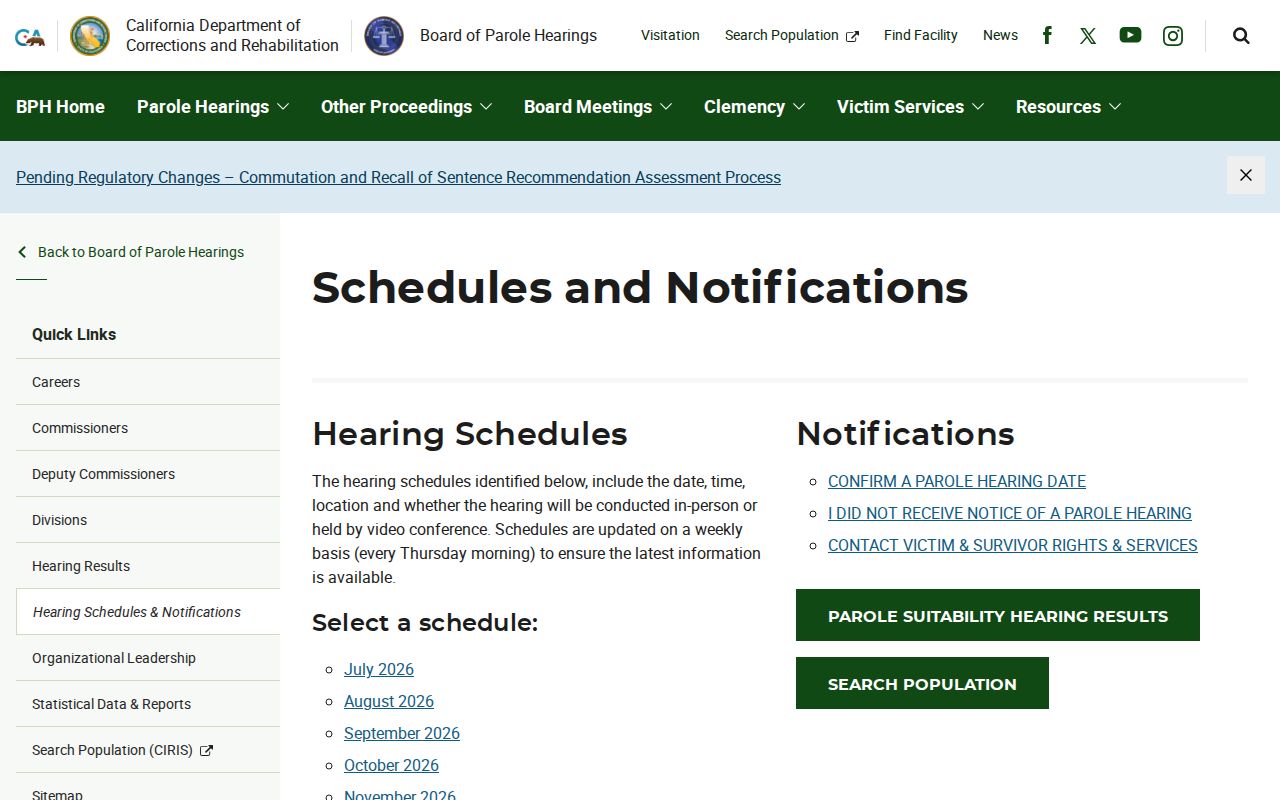
A Calaveras County conviction can lead to a CDCR sentence. If the person has an indeterminate sentence or another case requiring parole suitability review, the Board of Parole Hearings becomes part of the release path. The BPH hearing schedule publishes hearing date, time, location, and whether the hearing is in person or by videoconference. The research found that the schedule page says it is updated weekly on Thursday morning.
The BPH results page is a state-prison release context source. Outcomes can include grants, denials, waivers, postponements, continuances, cancellations, and related procedural results. A parole grant is not always physical release on the hearing date because review periods and statutory steps can still apply. California Penal Code section 3041 is the key statute captured in the research for parole suitability timing.
The official Board of Parole Hearings schedule is the source shown for state parole-hearing context.
Calaveras County Warrants After Release
Conditions are the rules set by a court, probation officer, parole officer, or CDCR parole authority. Public records may show only part of those rules. A court docket might show a probation grant, a violation hearing, a modification, or a bench warrant. A DAPO or CDCR record might address parole status. A released person can also have a separate warrant issue that does not prove the original release date or release reason.
Calaveras Citizen RIMS includes a public warrants route. That route is useful for a narrow check: whether a public warrant is listed. It is not a Calaveras County release list, and it is not a complete supervision record. If the warrant question is tied to probation, compare the warrant view with the Superior Court register of actions. If the question is tied to parole, use CDCR or DAPO channels.
- Probation
- Local court supervision that may follow or replace a county jail sentence.
- Parole
- State supervision after release from CDCR prison custody.
- Absconder
- A supervision term often used when a person is alleged to have stopped reporting or cannot be located by the supervising agency.
- Discharge
- The end of a custody or supervision term, if confirmed by the agency that controls the record.
Calaveras County Release Records
Personal property, identification, and record-correction questions should go to the agency that created the record. The Calaveras County Adult Detention Facility page provides the jail phone and hours, but no public release-property policy was found in the research. The Sheriff Records/Civil Division is the fallback for booking and release records, including the release date, release reason, and any transfer destination that is legally releasable.
If the problem is a court docket entry, contact the Superior Court rather than probation or the jail. If the problem is state custody or parole, use CDCR records or DAPO. If the issue involves a public registry record, use the agency correction channel tied to that registry. California public-records law allows access to many government records, but law-enforcement, juvenile, sealed, medical, and safety-sensitive material may be withheld or redacted.
Note: For a named release record, the broader Calaveras County released inmates workflow starts at Home and routes by custody type.
Calaveras County Supervision Ends
Supervision can end by court order, probation completion, probation termination, CDCR parole discharge, revocation, transfer, or another lawful change. The public record will depend on the system. A county probation end point may appear in the Superior Court register of actions or probation records. A parole end point belongs to CDCR and DAPO. A jail release record may show that the person left the Adult Detention Facility, but it may not show every later supervision event.
For Calaveras County, the strongest proof often comes from comparing records rather than relying on one screen. Use the court docket for the legal order, the Sheriff's release record for the jail event, probation for local supervision routing, and CDCR parole channels for state parole. If a public source conflicts with what a person was told at release, ask the originating office to verify the record and explain any redactions or limits.